
An X-ray Laser
January 30, 2012 Many years ago, I collaborated with scientists of the Stanford Linear Accelerator Center, now known as the SLAC National Accelerator Laboratory, on an interesting project. The SLAC experiment was on resonant nuclear diffraction, and my task was the preparation of epitaxial layers of yttrium iron garnet with isotopically-enriched iron (57Fe). The isotopically-enriched iron oxide I was given had a high monetary value, and it was loaned to SLAC from another source. I needed to keep the small bottle of iron oxide in my safe along with the platinum ware. After my crystal growth, the iron was reclaimed chemically from the residue in my crucible. Both the SLAC team and I used X-rays to characterize the crystalline quality of this material. In a special X-ray diffraction apparatus called a double crystal diffractometer it's possible to measure the width of the X-ray diffraction lines, and this is indicative of the quality of the crystal. X-rays are an extremely useful portion of the electromagnetic spectrum. X-rays have been the motivation for quite a few Nobel Physics Prizes. There is, of course, Wilhelm Röntgen, who won the first Nobel Physics Prize in 1901 for his discovery of X-rays, and also the following:• Max von Laue, who won the 1914 Prize for his discovery of the diffraction of X-rays by crystals.
The father and son team of William Henry Bragg and William Lawrence Bragg, who won the 1915 Prize for X-ray crystallography.
• Charles Glover Barkla, who won the 1917 Prize for X-ray spectroscopy.
• Manne Siegbahn, who won the 1924 Prize for X-ray spectroscopy.
• Riccardo Giacconi, who won the 2002 Prize for the discovery of cosmic X-ray sources.
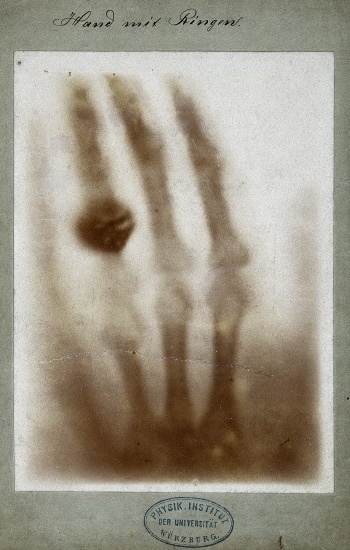 | The first medical X-ray. This is a print of one of Röntgen's first X-rays, that of his wife's hand. This X-ray, dated December 22, 1895, is entitled Hand mit Ringen (Hand with Ring). (Via Wikimedia Commons). |

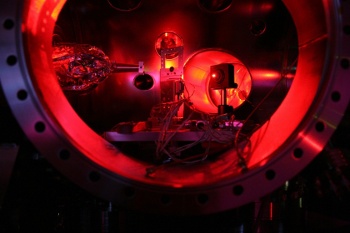 | The interior of an LCLS experimental chamber at SLAC. This chamber contained the aluminum foil specimen that was transformed into two million degree hot dense matter. (Photo by Sam Vinko/University of Oxford, via SLAC Web Site.) Used with permission. |

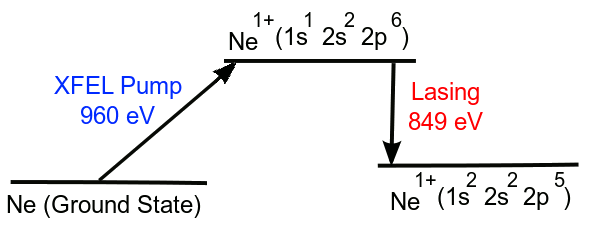 X-ray lasing in neon. The X-ray free electron laser (XFEL) pumps the gas at 960 eV, and the lasing transition emits X-rays at 849 eV (1.46 nm). (Illustration by author, rendered by Inkscape).
Since the SLAC Linac Coherent Light Source is already an X-ray laser, why would you want to use it to generate X-rays in neon? The neon X-rays are more monochromatic, having about 12% the linewidth of the LCLS.[8]
One interesting conjecture about X-ray lasers was recited by Adrian Cho in his review of SLAC neon X-ray laser in Science. Cho says that development of an X-ray laser may have been part of the US Strategic Defense Initiative in the 1980s. In that case, the pump source would have been an underground nuclear explosion![3]
X-ray lasing in neon. The X-ray free electron laser (XFEL) pumps the gas at 960 eV, and the lasing transition emits X-rays at 849 eV (1.46 nm). (Illustration by author, rendered by Inkscape).
Since the SLAC Linac Coherent Light Source is already an X-ray laser, why would you want to use it to generate X-rays in neon? The neon X-rays are more monochromatic, having about 12% the linewidth of the LCLS.[8]
One interesting conjecture about X-ray lasers was recited by Adrian Cho in his review of SLAC neon X-ray laser in Science. Cho says that development of an X-ray laser may have been part of the US Strategic Defense Initiative in the 1980s. In that case, the pump source would have been an underground nuclear explosion![3]
References:
- D.M. Gualtieri, W. Lavender and S. Ruby, "57Fe-YIG: Narrow Xray Linewidth Epitaxial Layers on Gd3Ga5O12," Journal of Applied Physics, vol. 63, no. 8 (April 15, 1988), pp. 3795-3797.
- J. Arthur, D. E. Brown, S. L. Ruby, G. S. Brown and G. K. Shenoy, "Studying hyperfine fields with resonant nuclear diffraction of x rays,", vol. 67, no. 9 (May 1, 1990), pp. 5705-5709.
- Adrian Cho, "Physicists Squeeze X-Ray Laser Light Out of Atoms," Science Now,January 25, 2012.
- Nina Rohringer, Duncan Ryan, Richard A. London, Michael Purvis, Felicie Albert, James Dunn, John D. Bozek, Christoph Bostedt, Alexander Graf, Randal Hill, Stefan P. Hau-Riege and Jorge J. Rocca, "Atomic inner-shell X-ray laser at 1.46 nanometres pumped by an X-ray free-electron laser," Nature, vol. 481, no. 7382 (January 26, 2012), pp. 488-491.
- Jon Marangos, "Laser science: Even harder X-rays," Nature, vol. 481, no. 7382 (January 26, 2012), pp. 452-453.
- Supplementary information for Ref. 5.
- Andy Freeberg, "World's Most Powerful X-ray Laser Creates 2-Million-Degree Matter," SLAC National Accelerator Laboratory Press Release, January 25, 2012.
- Richard Chirgwin, "Two million-degree matter from SLAC laser," The Register (UK), January 25, 2012.
- Adam Mann, "X-Ray Laser Turns Up the Heat to 3.6 Million Degrees," Wired, January 25, 2012.
- J. Arthur, D. E. Brown, S. L. Ruby, G. S. Brown and G. K. Shenoy, "Studying hyperfine fields with resonant nuclear diffraction of x rays,", vol. 67, no. 9 (May 1, 1990), pp. 5705-5709.