
A Hundred Years of Superconductivity
April 8, 2011 Today marks the hundredth anniversary of the discovery of superconductivity. The Dutch physicist Heike Kamerlingh Onnes, observed superconductivity in mercury at 4.2 K (-269 °C) on April 8, 1911. This experiment was possible only because Onnes was the first to liquify helium, a liquid with a boiling point of 4.2 K, on July 10, 1908. With liquid helium, Onnes was able to attain an ultimate low temperature of about 1 K (-272 °C) through the cooling effect of forced evaporation of the liquid. Onnes and the Scottish physicist, James Dewar of the eponymous Dewar flask, had been racing to achieve lower and lower temperatures. Dewar was the first to liquify hydrogen in 1888. Hydrogen has a boiling point of 20.28 K (-252.87 °C). Onnes won the race to liquefy helium, and this scientific competition was nicely dramatized in the NOVA special, "Absolute Zero," that aired in January, 2008.[1] Possibly because he had beat Dewar to liquefaction of helium and wanted a little vacation, Onnes decided to do some experiments on material properties at low temperatures. One of the easiest properties to measure is electrical resistance. It was well known that impurities decrease the electrical conductivity of metals.[2] In a simple classical model, the electrons racing through the solid are scattered by the impurity atoms. For this reason, Onnes decided to use mercury in his initial experiments, since it could be distilled to high purity. Furthermore, using mercury, which is a liquid at room temperature, made the experiment that much easier, since Onnes didn't need to worry about electrical contacts. Precise resistance measurements need four electrical contacts, two of which must be accurately spaced. Unknown to Onnes at the time, mercury was a fortuitous choice. If he had chosen any of the obvious metals, such as gold, silver or copper, he wouldn't have seen superconductivity.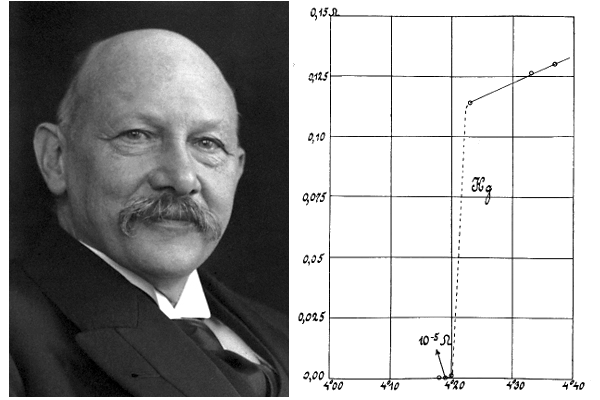 Heike Kamerlingh Onnes and the discovery of superconductivity. Photo from Wikimedia Commons / Image from Wikimedia Commons.
As Onnes reduced the temperature of mercury, he saw an abrupt transition to zero resistance at 4.2 K. Good experimentalist as he was, he immediately suspected a problem with his apparatus. One cause of the observed effect would be if the current-carrying leads shorted, so there would be no voltage drop across his specimen. After repeated checks, which were quite necessary since no other lab at the time had liquid helium and were capable of reproducing his result, Onnes published his finding. He initially referred to the phenomenon as "supraconductivity," but later called it "superconductivity."[3]
Onnes published his results in 1911 in the house journal, "Communications of the Physical Laboratory at the University of Leiden,"[4-6] but I'm sure offprints were widely circulated. Inspired by his mercury result, Onnes discovered the superconductivity of lead (at 7.19 K) and tin (at 3.72 K). Onnes was quickly awarded the Nobel Prize in Physics in 1913 "for his investigations on the properties of matter at low temperatures which led, inter alia, to the production of liquid helium." Dewar came away with nothing, and the NOVA documentary casts him as an unlikeable character.[1] Onnes, as his photo indicates, seems more like the kindly grandfather type.
It took quite a few year's after Onnes' discovery for physicists to provide an explanation of this unique, and quite useful, phenomenon.[7] In 1957, John Bardeen, Leon Cooper and John Schrieffer proposed their theory of how phonons assist in the electron pairing mechanism responsible for this unique quantum state. Bardeen, Cooper and Schrieffer were awarded the Nobel Physics prize in 1972, the second such award for Bardeen, who was coinventor of the transistor.
I've gone through a lot of liquid helium in my time. My coworkers and I did experiments with a three Tesla superconducting magnet that led to publication of my only Physical Review Letter.[8] Such magnets were the principal use of superconductivity in its early technology. Today, superconductivity provides a means to measure very small magnetic fields via superconducting quantum interference devices (SQUIDs); and precise voltage standards based on the Josephson effect.[9]
Heike Kamerlingh Onnes and the discovery of superconductivity. Photo from Wikimedia Commons / Image from Wikimedia Commons.
As Onnes reduced the temperature of mercury, he saw an abrupt transition to zero resistance at 4.2 K. Good experimentalist as he was, he immediately suspected a problem with his apparatus. One cause of the observed effect would be if the current-carrying leads shorted, so there would be no voltage drop across his specimen. After repeated checks, which were quite necessary since no other lab at the time had liquid helium and were capable of reproducing his result, Onnes published his finding. He initially referred to the phenomenon as "supraconductivity," but later called it "superconductivity."[3]
Onnes published his results in 1911 in the house journal, "Communications of the Physical Laboratory at the University of Leiden,"[4-6] but I'm sure offprints were widely circulated. Inspired by his mercury result, Onnes discovered the superconductivity of lead (at 7.19 K) and tin (at 3.72 K). Onnes was quickly awarded the Nobel Prize in Physics in 1913 "for his investigations on the properties of matter at low temperatures which led, inter alia, to the production of liquid helium." Dewar came away with nothing, and the NOVA documentary casts him as an unlikeable character.[1] Onnes, as his photo indicates, seems more like the kindly grandfather type.
It took quite a few year's after Onnes' discovery for physicists to provide an explanation of this unique, and quite useful, phenomenon.[7] In 1957, John Bardeen, Leon Cooper and John Schrieffer proposed their theory of how phonons assist in the electron pairing mechanism responsible for this unique quantum state. Bardeen, Cooper and Schrieffer were awarded the Nobel Physics prize in 1972, the second such award for Bardeen, who was coinventor of the transistor.
I've gone through a lot of liquid helium in my time. My coworkers and I did experiments with a three Tesla superconducting magnet that led to publication of my only Physical Review Letter.[8] Such magnets were the principal use of superconductivity in its early technology. Today, superconductivity provides a means to measure very small magnetic fields via superconducting quantum interference devices (SQUIDs); and precise voltage standards based on the Josephson effect.[9]


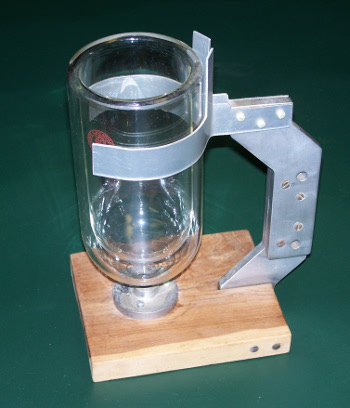 | What low temperature physicists do in their spare time. A beer mug crafted from a laboratory Dewar flask. |
References:
- PBS, "NOVA - Absolute Zero," January 8 and 15, 2008.
- American Physical Society, "Heike Kamerlingh Onnes," This Month in Physics History, vol. 16, no. 4 (April, 2007).
- Another source of resistance, called the Kondo effect, kicks in at very low temperatures, but such an effect was not known to Onnes.
- H. Kamerlingh Onnes, "Further experiments with liquid helium. C. On the change of electric resistance of pure metals at very low temperatures, etc. IV. The resistance of pure mercury at helium temperatures." Comm. Phys. Lab. Univ. Leiden; No. 120b, 1911.
- H. Kamerlingh Onnes, "Further experiments with liquid helium. D. On the change of electric resistance of pure metals at very low temperatures, etc. V. The disappearance of the resistance of mercury." Comm. Phys. Lab. Univ. Leiden; No. 122b, 1911.
- H. Kamerlingh Onnes, "Further experiments with liquid helium. G. On the electrical resistance of pure metals, etc. VI. On the sudden change in the rate at which the resistance of mercury disappears." Comm. Phys. Lab. Univ. Leiden; No. 124c, 1911.
- Joerg Schmalian, "Failed theories of superconductivity," arXiv Preprint Server, August 5, 2010
- P. Duffer, D.M. Gualtieri, and V.U.S. Rao, "Pronounced Isotope Effect in the Superconductivity of HfV2 Containing Hydrogen (Deuterium)," Physical Review Letters, vol. 37, no. 21 (November 22, 1976), 1410-1413.
- Celebrating the Centennial of the Discovery of Superconductivity, NIST Online Museum of Quantum Voltage Standards
- American Physical Society, "Heike Kamerlingh Onnes," This Month in Physics History, vol. 16, no. 4 (April, 2007).