
IBM Selectric Typewriter
August 3, 2011 I used many Selectric typewriters in my early career, and I even bought one while I was a post-doc. My first published papers were typed on Selectrics, and I used Selectric computer terminals, called IBM 2741 terminals, attached to IBM System/360 and System/370 series mainframe computers. I personally typed my dissertation on a rented Selectric II. Since those were the days before word processing, the Selectric that I rented had a correcting feature that would mechanically "lift" letters from the page. The Selectric was introduced as an IBM product fifty years ago, on July 31, 1961, when I was a high school freshman.[1-3]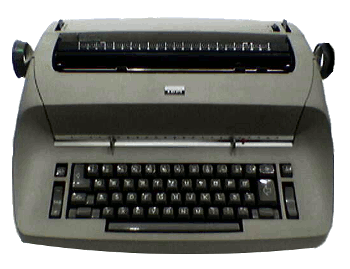 | An IBM Selectric Typewriter Photograph by Oliver Kurmis, via Via Wikimedia Commons. |

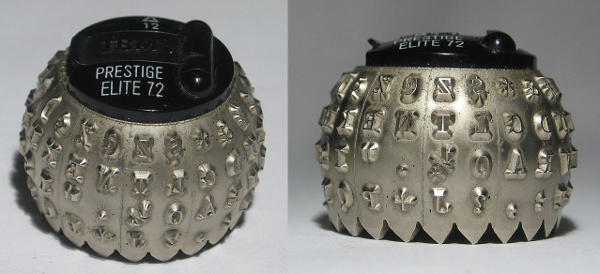 An IBM Selectric typeball (Prestige Elite), shown here as a composite of two Wikimedia Commons images, here and here.
I mentioned that Selectrics were used as computer terminals, also, so it wasn't much of a stretch to build a word processor around a Selectric. One very successful version of this was the Magnetic Card Selectric Typewriter. The data storage was on a magnetic analog of the venerable punch card, and the process was cumbersome, since the only I/O was through the typewriter.
A lot of paper was consumed in getting that perfect, final version of your typescript, but this word processing system was very popular. About 13 million Selectrics of all types were sold by 1986,[1] and at one time it held seventy-five percent of the US market.[2]
IBM missed an opportunity in computer terminals, since the Selectric didn't speak "ASCII," and it had a limited character set of just the 44 typewriter characters and their upper case values. Bob Bemer, an IBM computer scientist who helped to define ASCII, argued in favor of ASCII compatibility, but his recommendation wasn't followed.[3] Computer people still used Selectrics as terminals for non-IBM computers. My IBM 2741 terminal spoke APL, compliments of the proper type ball.
Eventually, an even more elegant impact-printing mechanism, the daisy wheel, was developed. Daisy wheel printers were faster, and they had fewer mechanical parts, while the heavy Selectric followed in the "Big Iron" tradition of the IBM mainframes of its era. I had a Diablo 630 daisy wheel printer in my office for most of the 1980s, and this was driven by my WordStar word processor program running on a CP/M computer.
An IBM Selectric typeball (Prestige Elite), shown here as a composite of two Wikimedia Commons images, here and here.
I mentioned that Selectrics were used as computer terminals, also, so it wasn't much of a stretch to build a word processor around a Selectric. One very successful version of this was the Magnetic Card Selectric Typewriter. The data storage was on a magnetic analog of the venerable punch card, and the process was cumbersome, since the only I/O was through the typewriter.
A lot of paper was consumed in getting that perfect, final version of your typescript, but this word processing system was very popular. About 13 million Selectrics of all types were sold by 1986,[1] and at one time it held seventy-five percent of the US market.[2]
IBM missed an opportunity in computer terminals, since the Selectric didn't speak "ASCII," and it had a limited character set of just the 44 typewriter characters and their upper case values. Bob Bemer, an IBM computer scientist who helped to define ASCII, argued in favor of ASCII compatibility, but his recommendation wasn't followed.[3] Computer people still used Selectrics as terminals for non-IBM computers. My IBM 2741 terminal spoke APL, compliments of the proper type ball.
Eventually, an even more elegant impact-printing mechanism, the daisy wheel, was developed. Daisy wheel printers were faster, and they had fewer mechanical parts, while the heavy Selectric followed in the "Big Iron" tradition of the IBM mainframes of its era. I had a Diablo 630 daisy wheel printer in my office for most of the 1980s, and this was driven by my WordStar word processor program running on a CP/M computer.


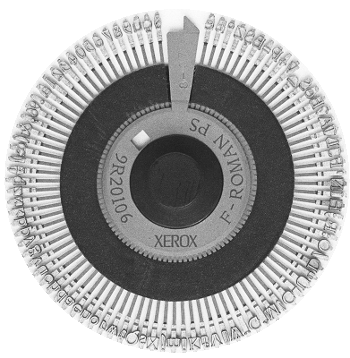 | Daisy wheel type element. (Via Wikimedia Commons). |
