
Laser Light, Laser White
November 8, 2011 I'm sure that nearly every reader of this blog is computer-savvy enough to know that the sixteen million colors on their display screen (actually, 224 = 16,777,216) are formed from just three colors - red, green and blue. These three colors were once generated by phosphors excited by electrons in the cathode rays tubes (CRTs) formerly used as display devices. Liquid crystal displays (LCDs), the present replacement for CRTs in desktop computing, use optical filters to derive these three colors from a white backlight. Many mobile devices use red, green and blue organic light-emitting diodes (OLEDs). The human eye is most sensitive to green light (520–570 nm), and much less sensitive to red light (630–740 nm) and blue light (440–490 nm). This is shown quantitatively in the figure below. The human eye, integrating over this spectrum, sees white light. As Isaac Newton so ably demonstrated in his prism experiments, white light is just a combination of colors, and a proper choice of red, green and blue light intensity will give an overall appearance of white light.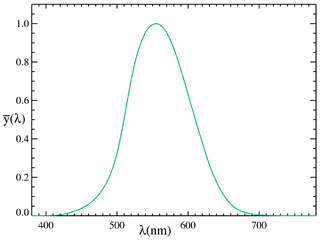 | The CIE Photoptic Luminosity Curve (1931) that quantifies human color vision. (Via Wikimedia Commons). |

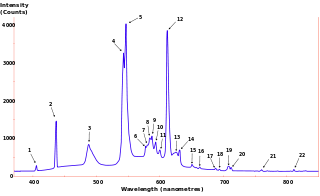 | Spectral output of a typical fluorescent lamp. Red, green and blue emissions come from excitations of Eu, Ce and Tb ions. Some Hg lines are also present. (Via Wikimedia Commons). |

| Color | Wavelength (nm) | Laser Type |
| Red | 625 | 800 mW AlGaInP laser diode |
| Yellow | 589 | 500 mW sum frequency generation of 1064 nm and 1319 nm from 808 nm laser-diode pumped Nd:YAG |
| Green | 532 | 300 mW frequency doubled 1064 nm from 808 nm laser-diode pumped Nd:YVO4 |
| Blue | 457 | 300 mW frequency doubled 914 nm from 808 nm laser-diode pumped Nd:YVO4 |
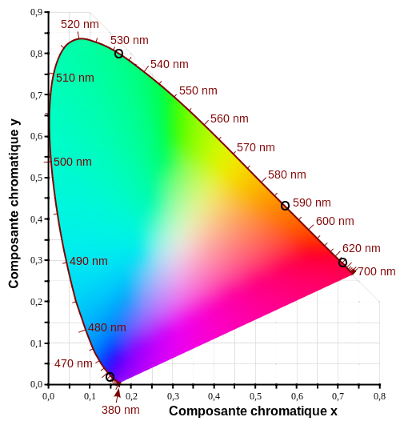 | The The CIE 1931 color space chromaticity diagram marked with the wavelengths of the laser light sources. White light is readily accessible to this color gamut. (Via Wikimedia Commons). |

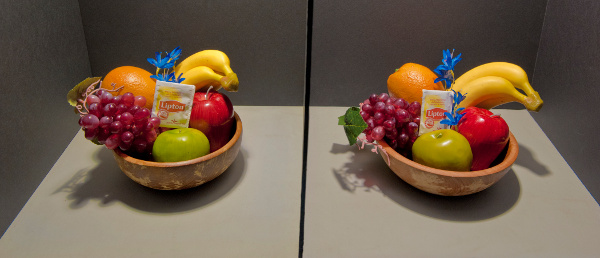 Still life scenes under different white illumination. In this photograph, the scene on the left was illuminated by a diode laser light and the scene on the right was illuminated by a standard incandescent bulb.(Sandia photo by Randy Montoya).
Five subjects were found to be color-blind, so their results were excluded from the dataset. The other participants were presented with eighty random pairings over the course of 10-20 minutes. Surprisingly, there was a statistically significant preference for the semiconductor laser white light over warm and cool LED white light. However, there was no statistically significant preference of laser over neutral LED or incandescent white light.[1-2]
One problem that appears in laser illumination that does not appear in other light sources is speckle. The Sandia team found that speckle detracted from image quality, especially for younger subjects with high visual acuity. To make an acceptable laser light source, they added considerable diffusion, which resulted in a 75% reduction in light intensity.[2] A different solution would be needed in a practical system.
The main stumbling block is that semiconductor lasers are still not sufficiently efficient and inexpensive to be used for illumination. The research team received colorimetric and experimental guidance from the National Institute of Standards and Technology. The work was supported by the Solid-State Lighting Science Energy Frontier Research Center, which is funded by the U.S. Department of Energy Office of Science.[1]
Still life scenes under different white illumination. In this photograph, the scene on the left was illuminated by a diode laser light and the scene on the right was illuminated by a standard incandescent bulb.(Sandia photo by Randy Montoya).
Five subjects were found to be color-blind, so their results were excluded from the dataset. The other participants were presented with eighty random pairings over the course of 10-20 minutes. Surprisingly, there was a statistically significant preference for the semiconductor laser white light over warm and cool LED white light. However, there was no statistically significant preference of laser over neutral LED or incandescent white light.[1-2]
One problem that appears in laser illumination that does not appear in other light sources is speckle. The Sandia team found that speckle detracted from image quality, especially for younger subjects with high visual acuity. To make an acceptable laser light source, they added considerable diffusion, which resulted in a 75% reduction in light intensity.[2] A different solution would be needed in a practical system.
The main stumbling block is that semiconductor lasers are still not sufficiently efficient and inexpensive to be used for illumination. The research team received colorimetric and experimental guidance from the National Institute of Standards and Technology. The work was supported by the Solid-State Lighting Science Energy Frontier Research Center, which is funded by the U.S. Department of Energy Office of Science.[1]

References:
- Neal Singer, "High-quality white light produced by four-color laser source," Sandia Labs Press Release, October 26, 2011.
- A. Neumann, J. J. Wierer, W. Davis, Y. Ohno, S. R. J. Brueck and J.Y. Tsao, "Four-color laser white illuminant demonstrating high color-rendering quality," Optics Express, vol. 19, no. S4 (July 4, 2011), pp. A982-A990.