
How Many Domains of Life?
September 13, 2011 Classification is an interesting problem. There's a box of miscellaneous bolts in my workshop, commonly called a "hell box" by machinists, where I often glean a piece or two for a project. If I were to classify the contents of this box, what characteristics of these bolts would I use? As someone who dabbles in computer science, I would use the classification scheme that makes the most sense from a search standpoint. In this case, it would be material type (steel, brass, nylon, etc.), then size (no. 2, 4, 6, 8, etc.), then thread pitch (20, 32, 40, etc). For me, material type is the most important characteristic, and this specifies my three "domains" for bolts. Biologists have the same problem in the classification of life, and the most fundamental question is how many domains of life are there? The first attempt at classification recognized just two domains. These were the Linnaean "super-kingdoms" of "prokaryotes" and "eukaryotes." Eukaryote cells (animals, plants and fungi) have a nucleus, and prokaryote cells (bacteria) do not.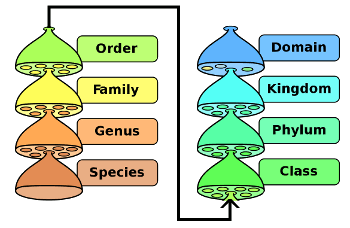 | Biological classification. Domain is the top level of species classification. (Image by Peter Halasz (modified) via Wikimedia Commons). |

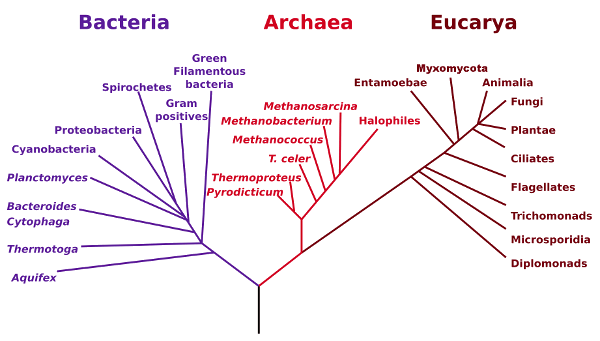 Phylogenetic Tree of Life. (NASA image via Wikimedia Commons).
Of course, getting scientists in any field to agree on something is difficult. Most follow the three domain system, but some still cling to the two super kingdoms of eukaryotes and prokaryotes. The Archaea are so rare that on a practical level, it doesn't really matter.
There's also the six-kingdom system of Eubacteria, Archaebacteria, Protista, Fungi, Plantae, and Animalia. This allows a top-level differentiation between plants and animals that's satisfying. What's important depends on whom you ask. As a non-voting, non-biologist, I'm a member of the three domain camp.
But wait! There's more! A recent news focus article in Nature by Gwyneth Dickey Zakaib reviews evidence for yet another domain of life.[5] This domain is that of giant viruses, and there may be others on the sidelines as evidenced by unexplained marine DNA.
The modus operandi of viruses is that they infect cells and hijack cellular mechanism for their own use. They can't reproduce outside of a host cell. To do what little they do, viruses don't need a very complicated genome, and they don't need to be large. A small size is actually an advantage.
That's why a virus discovered in 1992 by Didier Raoult of the University of the Méditerranée in Marseille, France, caused such a stir. This Mimivirus, the first so-called "giant virus," had a total length of 600 nm; that is, it's so large that it's visible under an optical microscope. Not only that, but its DNA has 1.2 million base pairs.[5]
Raoult's team discovered another giant virus, named Marseillevirus, in 2009. Isolated from amoebae, it has a 368 kilo-base-pair genome that encodes at least 49 proteins. Raoult considers the Mimivirus, Marseillevirus, and their giant virus cousins, to be part of a new domain of life, a fourth domain.
This new domain is called, quite non-poetically, Nucleocytoplasmic Large DNA Viruses (NCLDVs). Raoult's proposal has met considerable resistance, just as Woese's third domain did years ago. Once again, on a practical level, it doesn't really matter, since the giant viruses are quite rare.
The rarity argument against other domains of life might not hold water (pun intended) considering research into uncategorized DNA sampled from the oceans. Such DNA has been called the "dark matter of the biological universe" by Jonathan A. Eisen of the University of California Davis (Davis, California).[5]
Eisen is an author of a PLOS One article entitled, "Stalking the Fourth Domain...," that examines these DNA sequences and metagenomic data.[6] The sequences are far removed from those of the known domains, and thus the mention of a fourth domain in his article's title.
Francisco Rodriguez-Valera a microbiologist at the Miguel Hernández University (Alicante, Spain), sums up the consensus in his field this way.
Phylogenetic Tree of Life. (NASA image via Wikimedia Commons).
Of course, getting scientists in any field to agree on something is difficult. Most follow the three domain system, but some still cling to the two super kingdoms of eukaryotes and prokaryotes. The Archaea are so rare that on a practical level, it doesn't really matter.
There's also the six-kingdom system of Eubacteria, Archaebacteria, Protista, Fungi, Plantae, and Animalia. This allows a top-level differentiation between plants and animals that's satisfying. What's important depends on whom you ask. As a non-voting, non-biologist, I'm a member of the three domain camp.
But wait! There's more! A recent news focus article in Nature by Gwyneth Dickey Zakaib reviews evidence for yet another domain of life.[5] This domain is that of giant viruses, and there may be others on the sidelines as evidenced by unexplained marine DNA.
The modus operandi of viruses is that they infect cells and hijack cellular mechanism for their own use. They can't reproduce outside of a host cell. To do what little they do, viruses don't need a very complicated genome, and they don't need to be large. A small size is actually an advantage.
That's why a virus discovered in 1992 by Didier Raoult of the University of the Méditerranée in Marseille, France, caused such a stir. This Mimivirus, the first so-called "giant virus," had a total length of 600 nm; that is, it's so large that it's visible under an optical microscope. Not only that, but its DNA has 1.2 million base pairs.[5]
Raoult's team discovered another giant virus, named Marseillevirus, in 2009. Isolated from amoebae, it has a 368 kilo-base-pair genome that encodes at least 49 proteins. Raoult considers the Mimivirus, Marseillevirus, and their giant virus cousins, to be part of a new domain of life, a fourth domain.
This new domain is called, quite non-poetically, Nucleocytoplasmic Large DNA Viruses (NCLDVs). Raoult's proposal has met considerable resistance, just as Woese's third domain did years ago. Once again, on a practical level, it doesn't really matter, since the giant viruses are quite rare.
The rarity argument against other domains of life might not hold water (pun intended) considering research into uncategorized DNA sampled from the oceans. Such DNA has been called the "dark matter of the biological universe" by Jonathan A. Eisen of the University of California Davis (Davis, California).[5]
Eisen is an author of a PLOS One article entitled, "Stalking the Fourth Domain...," that examines these DNA sequences and metagenomic data.[6] The sequences are far removed from those of the known domains, and thus the mention of a fourth domain in his article's title.
Francisco Rodriguez-Valera a microbiologist at the Miguel Hernández University (Alicante, Spain), sums up the consensus in his field this way.

"There is a huge amount of microbial diversity that is unknown. I don't think we need to discover a new domain every ten years to convey to the general public the fact that microbes are important."[5]
References:
- Diana Yates, "Symposium marks 30th anniversary of discovery of third domain of life" (University of Illinois Press Release, October 16, 2007).
- George E. Fox, Linda J. Magrum, William E. Balch, Ralph S. Wolfe and Carl R. Woese, "Classification of Methanogenic Bacteria by 16S Ribosomal RNA Characterization," Proc. Natl. Acad. Sci., vol. 74, no. 10 (October 1, 1977), pp.4537-4541.
- Carl R. Woese and George E. Fox, "Phylogenetic Structure of the Prokaryotic Domain: The Primary Kingdoms," Proc. Natl. Acad. Sci. vol. 74, no. 11 (November 1, 1977), pp. 5088-5090.
- Carl R. Woese, Otto Kandler and Mark L. Wheelis, "Towards a natural system of organisms: proposal for the domains Archaea, Bacteria, and Eucarya," Proc. Natl, Acad. Sci., vol. 87, no. 12 (June 1, 1990), pp. 4576-9 .
- Gwyneth Dickey Zakaib, "The challenge of microbial diversity: Out on a limb," vol. 476, no. 7358 (August 4, 2011) pp. 5-120.
- Dongying Wu, Martin Wu, Aaron Halpern, Douglas B. Rusch, Shibu Yooseph, Marvin Frazier, J. Craig Venter and Jonathan A. Eisen, "Stalking the Fourth Domain in Metagenomic Data: Searching for, Discovering, and Interpreting Novel, Deep Branches in Marker Gene Phylogenetic Trees," PLoS ONE, vol. 6, no. 3 (2011), Document No. e18011.
- Gwyneth Dickey Zakaib, "The challenge of microbial diversity: Out on a limb," vol. 476, no. 7358 (August 4, 2011) pp. 5-120.