
Geomagnetic Alignment of Cattle
February 11, 2011 It appears that statistical analysis has become a current topic on this blog. That might be because so many scientific papers rely on a statistical analysis of data. In a previous article (The North Side of the Cow, September 03, 2008), I reported on the interesting finding that showed that cows tend to point north, or maybe south, but not in between [1-3]. This was found in an analysis of Google Earth images of 308 pastures and 8,510 grazing and resting cattle by Sabine Begall and Hynek Burda of the University of Duisburg-Essen, Germany, and a research team from the Czech Republic. They weren't able to tell the head from the tail end of the cows from these images, but the cattle aligned themselves mostly (60-70%) in a north-south direction. The same effect was observed for 2,974 grazing and resting red and roe deer at 241 localities.[3] In that case, the head orientation could be observed, and it was found that the deer tend to point their heads northward. These results were somewhat believable; first, because the paper was published in the Proceedings of the National Academy of Sciences;[3] and because a variety of animals from bees to bats have been found to be sensitive to the Earth's magnetic field. Science, of course, is built on a foundation of reproducibility, so it's no wonder that there's been a follow-up study.[4] The follow-up study did not confirm the effect. The follow-up study, by researchers in the Czech Republic, examined 232 herds with 3,412 cattle. The analysis was done by two independent groups, and no alignment of cattle along geomagnetic field lines was found. The authors write that the poor resolution of the Google satellite photographs, as well as a possible subconscious bias and other technical factors, may have been the reason for the prior positive result. Of course, there are the usual problems of a statistical study, as the authors note.[4]To obtain a sufficient number of observations to allow statistically significant conclusions, a large amount of data - usually considerably dispersed and sometimes contradictory - needs to be collected. This may be expensive and time-consuming.To show how easily too little data can mislead, examine the following photograph from the supplemental materials of the recent study.[5]
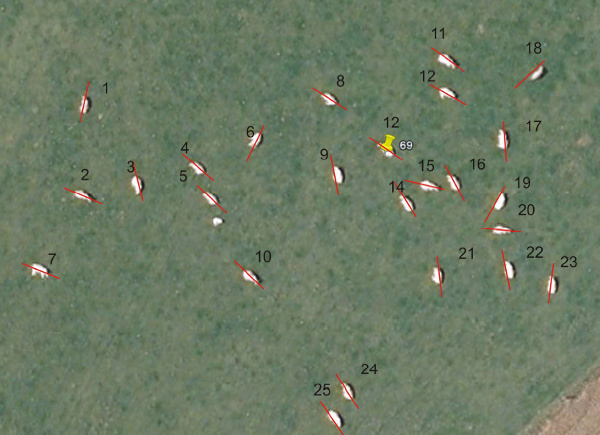 A herd of cattle at pasture at N54°57'8'', E-1°46'26''. From Ref. 4.
If we analyze just this particular herd, it appears that there's a strong inclination for the cattle to orient in a particular direction, as the histogram shows.
A herd of cattle at pasture at N54°57'8'', E-1°46'26''. From Ref. 4.
If we analyze just this particular herd, it appears that there's a strong inclination for the cattle to orient in a particular direction, as the histogram shows.
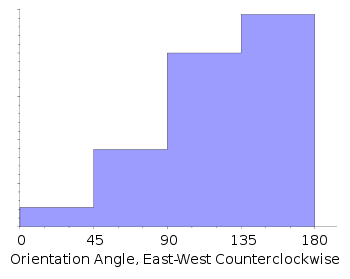 | Histogram showing the orientation of the herd of cattle at pasture in the above photograph. Analysis using Gnumeric |
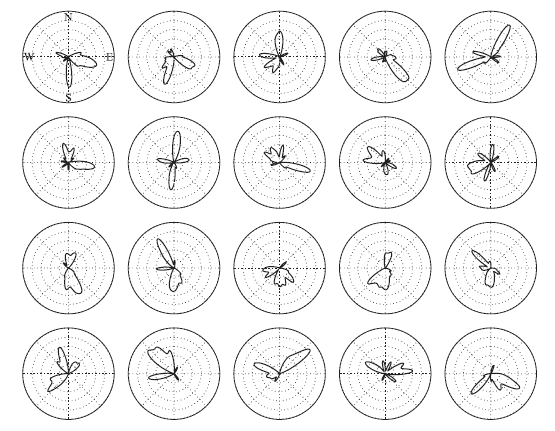 Probability density function drawn for 20 herds randomly selected from 40 herds
with well resolved positions of heads; and with a similar number of cows. Fig. 3 from Ref. 3.
Probability density function drawn for 20 herds randomly selected from 40 herds
with well resolved positions of heads; and with a similar number of cows. Fig. 3 from Ref. 3.
References:
- Elizabeth Mitchell, "Cattle shown to align north-south" (BBC News, August 25, 2008).
- Randolph E. Schmid, "Cows seem to know which way is north" (Boston.com, August 25, 2008).
- Sabine Begall, Jaroslav Cerveny, Julia Neef, Oldrich Vojtcch, and Hynek Burda, "Magnetic alignment in grazing and resting cattle and deer," Proc. Natl. Acad. Sci., vol. 105, no. 36 (September 9, 2008), pp.13451-13455.
- J. Hert, L. Jelinek, L. Pekarek and A. Pavlicek, "No alignment of cattle along geomagnetic field lines found," arXiv Preprint Server, February 1, 2011.
- J. Hert, L. Jelinek, L. Pekarek and A. Pavlicek, Supporting Materials for "No alignment of cattle along geomagnetic field lines found," arXiv Preprint Server, February 1, 2011.