
Generating X-rays
July 5, 2011 Gen-X would have been a good name for an X-ray equipment company. Unfortunately, the term has been usurped as the name of the generation born after the baby boom of which I was a part. Gen-X a fuzzy term, meaning different things to different people. It's most commonly applied to people born in the 1960s and 1970s. They missed Sputnik, but many of them experienced the first manned moon landing. That's quite a leap in technology in just one generation! Like most materials scientists, I did a lot of work with X-rays. There was routine powder diffraction analysis of phases, but there was also the more exotic linewidth determination by a double-crystal diffractometer to determine the quality of single crystals. Having worked with X-rays for many years, I have two interesting anecdotes. The first comes from the time when my fellow graduate students and I were first learning X-ray technique. Since we were working with X-rays, we each needed X-ray dosimeter badge. One of the students didn't quite understand the badge concept, so he asked how a small piece of plastic could protect him from the X-rays. Then there was the month when all the dosimeter badges in our laboratory showed an exposure. We checked all three machines in the room, and there were no stray X-rays emitted by any. As it turned out, someone who was working with a harmless tracer chemical had left a vial of it on the shelf where everyone kept their exposure badges. The generation of X-rays is quite simple. So simple, in fact, that equipment not designed to emit X-rays can emit them. Electrons of sufficiently high energy impacting materials will generate X-rays. All you need is a source of high energy electrons and a target. There aren't that many cathode ray tubes out there, now, but the introduction of color television caused a problem. Color television tubes incorporate a shadow mask to define the color fields on the phosphor screen, and electrons impacting on this screen generate X-rays. The electrons impacting on the phosphor are less of a problem, since the phosphor elements needed higher electron energies to produce X-rays. Not surprisingly, such emissions are limited by law, but CRT televisions are now a rarity. Wilhelm Röntgen was awarded the first Nobel Prize in Physics in 1901 for his discovery of X-rays in 1895. X-rays soon became a common tool for scientific and medical investigations. By 1933, a patent was issued for the first rotating anode X-ray tube for generating extremely high X-ray power.[1] One of my aunts had X-ray treatments for acne in the 1930s, a medical procedure that's not currently recommended!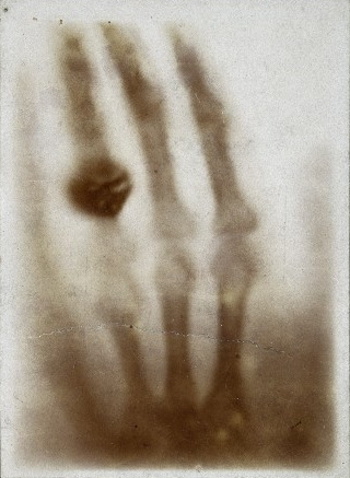 | The first medical X-ray. Hand mit Ringen: Wilhelm Röntgen's x-ray of his wife's hand, taken on December 22, 1895. (Via Wikimedia Commons) |

References:
- Albert Bouwers, "X-Ray Tube," US Patent No. 1,933,005, Oct 31, 1933
- Stefan Kneip, "Applied physics: A stroke of X-ray," Nature, vol. 473, no. 7348 (May 26, 2011), pp. 455-456.
- Seth Putterman, James K. Gimzewski, Brian B. Naranjo, "High energy crystal generators and their applications," US Patent No. 7,741,615, June 22, 2010.
- Brian Naranjo, James Gimzewski, Seth Putterman, "Method And Apparatus For Generating Nuclear Fusion Using Crystalline Materials,"US Patent Application No. 11/745,556, Publication number: US 2008/0142717 A1, May 8, 2007.
- Carlos G. Camara, Juan V. Escobar, Jonathan R. Hird and Seth J. Putterman, "Correlation between nanosecond X-ray flashes and stick–slip friction in peeling tape," Nature, vol. 455, no. 7216 (October 23, 2008), pp. 1007-1148.
- Thomas H. Maugh II, "UCLA researchers' surprising finding could lead to applications in medicine, other fields," LA Times, October 25, 2008.
- Kenneth Chang, "Scotch Tape Unleashes X-Ray Power," The New York Times, October 28, 2008
- Dave Bullock, "Gallery: Take an X-Ray With Your Office Sticky Tape," Wired, October 22, 2008 .
- J. R. Hird, C. G. Camara, and S. J. Putterman, "A triboelectric x-ray source," Applied Physics Letters, vol. 98, no. 13 (March 28, 2011), Document No. 133501 (3 pages).
- Stefan Kneip, "Applied physics: A stroke of X-ray," Nature, vol. 473, no. 7348 (May 26, 2011), pp. 455-456.